 TEBAMI
When is a decimal useful?
A tape measure may show sixteenths while a drawing, spreadsheet or digital measuring tool uses decimals. Converting the number lets you compare the two without changing the measurement. The same fraction method works for any unit, but converting a fraction does not itself convert inches into millimetres.
Method and worked examples
For a fraction a/b, decimal value = a ÷ b. The denominator cannot be zero. For a positive mixed number, add the whole number after dividing the fractional part.
7/16 → 0.4375
7 ÷ 16 = 0.4375.
2 3/8 → 2.375
2 + (3 ÷ 8) = 2 + 0.375 = 2.375.
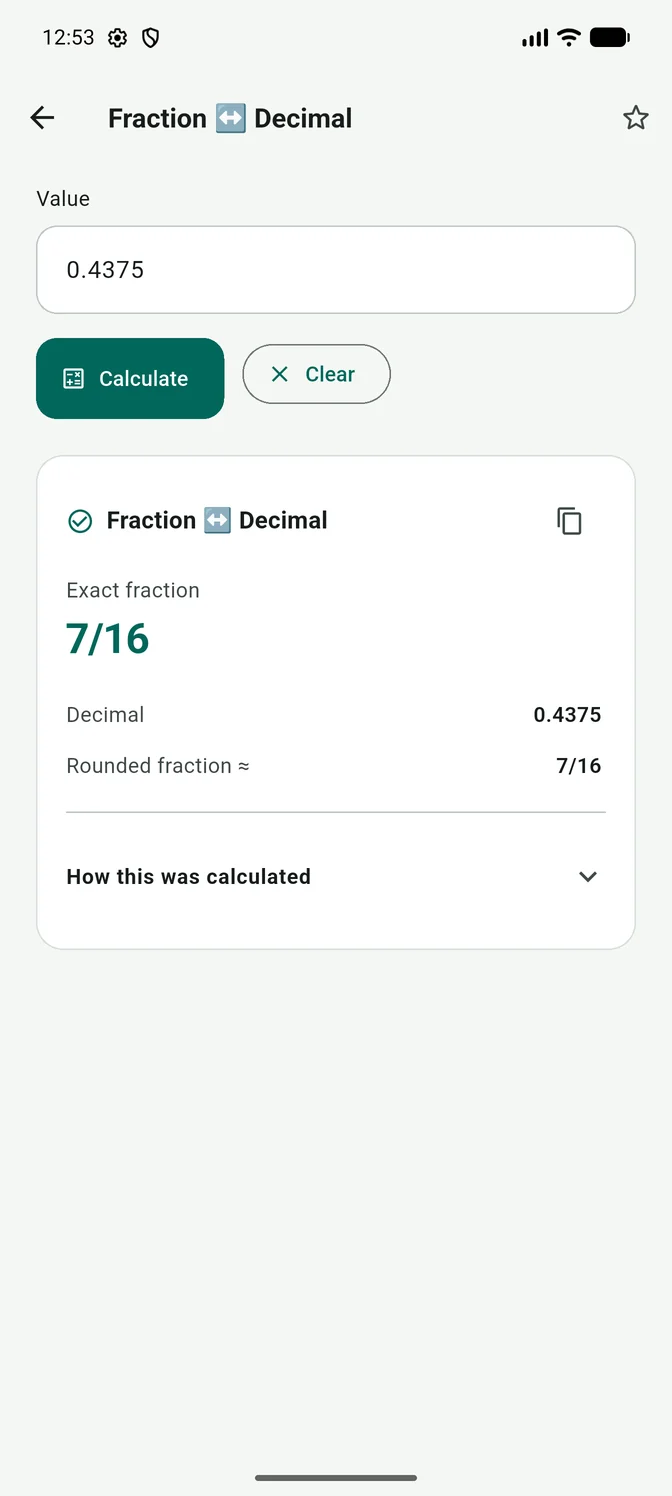
0.4375 → 7/16
4375/10000 reduces to 7/16.
If the first value means inches, 0.4375 in is still an inch measurement. Multiply by exactly 25.4 to obtain 11.1125 mm. Tebami also has a separate Free Fraction ↔ Millimetres tool for that conversion.
Try it in Tebami
- Find Fraction ↔ Decimal in Conversions or Search.
- Enter 7/16 in Value, then tap Calculate.
- Read Decimal: 0.4375. Enter 0.4375 to check the reverse conversion to 7/16.
- Open “How this was calculated” for the method.
Exact fractions and rounded displays
Tebami retains entered decimal and fractional values as rational numbers in this calculation. Decimal display is limited to ten decimal places, so repeating decimals such as 1/3 need rounding. “Rounded fraction ≈” uses the selected fraction precision, with halfway values rounded away from zero. A rounded fraction can differ from the exact fraction; choose the precision appropriate to the work.
Do not treat extra decimal digits as evidence that a tape measurement was more precise. Keep the original value when making several calculations.
Related measurement help
For lengths containing both feet and inches, see feet and inches calculations. For the general display rules, read calculation accuracy and rounding.
Reference: NIST’s length-unit explanation confirms the exact inch-to-millimetre relationship.